Sunday, January 24, 2021

Concentration Camp

Most people who want to experience a concentration camp while visiting Krakow go to Auschwitz. And for good reason, too. Auschwitz is probably the most recognizable name of any concentration camp and it's only an hour west of Krakow. Although I haven't been yet, I know that visiting Auschwitz-Birkenau is an immersive experience and makes it onto the to-do list of any history-savvy Krakow visitor. But, even though most tourists won't hear about it, Krakow is home to its own Nazi concentration camp within the city limits: the Krakow-Płaszów concentration camp ("Płaszów"). 

Unlike Auschwitz, the former structures of Płaszów have not been kept up. The only buildings that still remain intact on the property are the Grey House, a former Jewish-owned building-turned to Nazi offices and jailhouse in 1942, and Amon Göth's villa, which is easy to miss as it is not marked by any signage and its renovations camouflage it with surrounding neighborhood homes. The rest of the grounds are now considered a memorial park and nature preserve with large open fields and lightly wooded hills. As you walk around the park (~80 hectares now, but at its largest the camp covered ~150 hectares), there are informational signs, a few memorials and monuments, some rubble, and typically a smattering of people taking their dogs and families for walks. You don't see much indicating that the land used to be surrounded by an electrical barbed-wired fence with guard towers nor that train tracks used to run through the property. 

It really is quite peaceful, which makes it difficult to reconcile the idea that 40,000 prisoners were there between the years of 1942-1945, with a max of 25,000 at one time (not including those who passed through as a transit camp). The site itself had previously been two Jewish cemeteries, and after a month of renovations (i.e. knocking over the gravestones and using slave labor to erect shanty living quarters) the Krakow Jewish ghetto was liquidated and those fit for work were transferred to Płaszów. Although the camp was initially intended to house Krakow Jews, it also imprisoned a large number of Hungarian Jews, Roma (Gypsies), and Polish prisoners (largely from the Warsaw Uprising). 

It was used as a labor camp, with a high concentration of women and children compared to other work camps. Although children were allowed there (at least in the beginning) they had to pull their weight, too. The hardest labor was working in the nearby quarries while children and the elderly tended to work as brush makers. Other labor included: sewing uniforms, electrical and automotive work, printing documents, and serving in armament factories, among other things. 

While some inmates stayed at the camp indefinitely (typically just a few months given the harsh labor conditions, starvation, typhus, and sadistic commander), for others it was merely a stop on the way to be killed at Auschwitz. That proved to be the case for many of the children. As one of the signposts indicates, in 1944, the Commandant Amon Göth declared that all of the children would be sent to "kindergarten," which truly meant that they were rounded up and sent to be gassed the next day. 

Göth was a brutal character. He started his first day at camp in February, 1943 by killing two of the camp's Jewish policemen, and then every day thereafter he shot at least one person before breakfast. In addition to regular shootings (it is thought that he singlehandedly murdered around 500 prisoners), hangings were common, and Göth also trained his two dogs (a Great Dane and a German Sheppard mix) to tear prisoners to death. He was also fond of collective punishment and mass murders. Göth stayed at the camp until September, 1944, when the Nazi Party charged him with theft of property (one of the roles at Płaszów was to sort through the gold and other valuables that were collected from the imprisoned and dead), violation of camp regulations & prisoner punishment, and failure to provide adequate food to the prisoners. After the war, he was tried by the Supreme National Tribunal of Poland and was hanged in Krakow in September, 1946. 

Though each of the 19 main informational signs have a quote from a Płaszów survivor and a small paragraph of information, they gloss over the true hardships of living in Płaszów (you know it was bad if the Nazi government decided the commander was being too brutal). Largely due to Göth's influence, Płaszów had one of the highest death rates of any labor camp. A typical week might consist of three or four truckloads of new laborers to replace those condemned to mass execution. As described by Halina Nelken, who was at Płaszów as a 20-year-old, the condemned were walked into a trench, ordered to strip naked, shot, and then covered with dirt as all other inmates watched. 

Clearly, fear was ever-present, as was hunger. One of the quotes posted in the park is from Aren Blumenkranz: "And, really they were getting maximum productivity out of us. We should have had a free Sunday once for three weeks, but just on that day a wagon of coal to be loaded was arriving or another job was found for us so time off was out of the question. Our food for a 12-hour working day was 1.4 kg of break weekly and 1 litter of thin soup daily." Those who worked as Jewish police at the camp were given double rations of thicker soup and more bread of higher quality, but they then were tasked with whipping fellow inmates (lashings were a common punishment). Once Göth was replaced, diets began to occasionally include eggs, sugar, and powdered milk.

Surprisingly to me, there was also some outside help. A few support groups and individuals were tolerated by the Germans and provided additional food and medicine to the camp. Some prisoners were employed outside of the camp (at Oskar Schindler's factory, for example), and could exchange their wages (which was by no means a required exchange for their labor) for additional food rations. While the extra nutrition was necessary, those found with smuggled items, even an extra piece of food, were subject to whippings or death. 

Those who are familiar with Schindler's List will recognize the concentration camp's name. If you look on a map, you'll see that Oskar Schindler's factory sits about 2km from the Płaszów SS Headquarters. A significant portion of the Jews that survived Płaszów were contracted out as staff at the enamel factory. For the movie, Steven Spielberg elected not to use the actual Płaszów site in order to leave it as is and honor the memory of its victims. The scenes that you see in the film are reconstructions built inside the Liban quarry (which actually was used for forced labor for many Płaszów inmates). 

The camp began to close down when threats from the Red Army became more prominent in summer of 1944. Most prisoners were deported to other concentration camps and the remaining few-hundred were tasked with breaking down the barracks and exhuming the bodies from 11 mass graves (in an attempt to hide the crimes). As documented by the Holocaust Education & Archive Research Team, it took 17 truckloads to rid the site of the human ashes. In the end, those remaining few were marched to Auschwitz to meet their ends. 

Now, there are a few monuments around the park, the most prominent of which is the 7 meter "Memorial to the Victims of Fascism in Krakow," carved by Ryszard Szczypiński and designed by architect Witold Cęckiewicz. The huge limestone block is a "homage to the martyrs murdered by Nazi genocide in 1943-1945," as is carved into the back of the stone. Another prominent one is a large cross topped with barbed wire, which marks one of the execution sites. It's strange that from the main part of the park you look over at a large hardware store and the cellar of Göth's house, which used to house his maids, is now being used as a wine cellar for the family that currently lives there. I have some mixed thoughts about the modernization of things, but I'm glad that in general Krakow makes space to acknowledge its history while making peace with the idea that time moves on and things change. 

There are a few of these signs on the perimeter of the park: "Dear Visitors! You are entering the site of the former Nazi German concentration camp "Płaszów". Please respect the grievous history of the site."


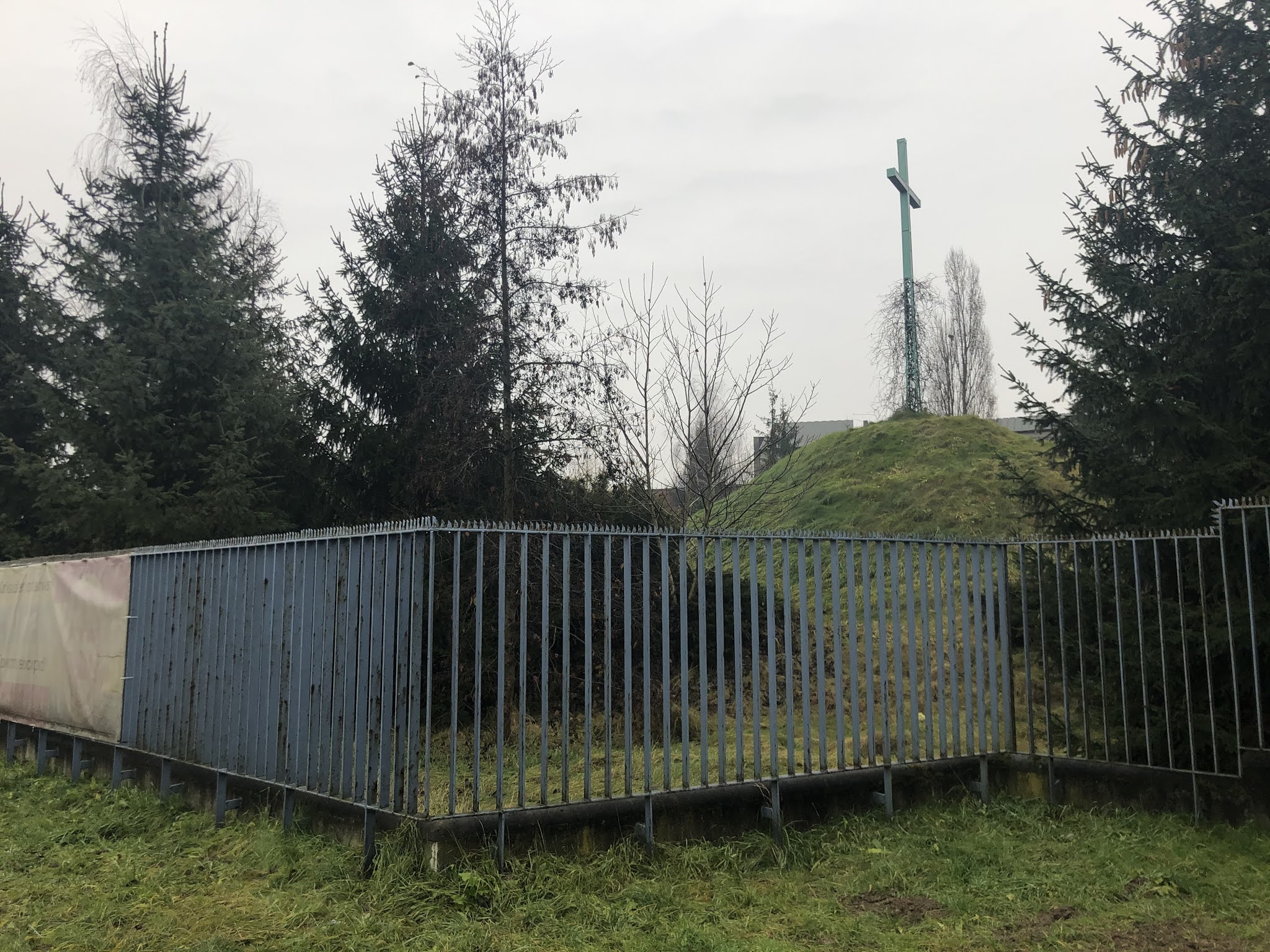
The barbed cross on the hill Hujowa Górka marks one of the mass execution sites. Apparently, the name is a bit of wordplay: a combination of Albert Hujar's name, who was the SS officer who ordered the first executions here, and the Polish words chujowa/chujowka/chuj, which is a vulgarity encompassing bitch/shit/prick/cock...you get the idea. 

The most imposing monument is visible from the nearby main road, Kamieńskiego. Nearby the "Memorial to the Victims of Fascism in Krakow" (also sometimes known as the "Memorial of Torn-Out Hearts") are two smaller memorials to remember the Hungarian Jewish women and all Jewish women of the camp. 

One of the 19 primary informational signs, this one discussing the mass executions/burials. You can also see the monolithic memorial in the background. 

The biggest area of the park is made up of large flat fields. Pre-war, these were Jewish cemeteries that were plowed-down and converted to barracks and factory areas during the time the camp was in operation. It is not uncommon to see picnickers and dog walkers in these fields. 

The lower end of the main field, in the south eastern end section of the park are piles of large ruble, which once were the pre-burial hall of the new cemetery of the Krakow Jewish Community. During the camp's existence, it was repurposed as a utility building that housed stables, pig farms, rabbit hutches, etc. It was partially detonated for Göth's amusement one night, and the remaining stucture was blown up in 1944 as part of the camp's final destruction. 

The smaller of the two former Jewish cemeteries still has some grave markers. The Germans removed these from their original locations and flattened them to make a road in the camp. The Schindler's List replica of the gravestone road (shown in the black-and white screenshot from the movie) can be found at the bottom of the Liban Quarry.

Looking up at that cemetery, you can see that there are a fair amount of gravestone remains. These were mostly buried and became Roll Call Square, which was sandwiched between the men's and women's barracks. They were only uncovered in the 2000s as part of conservation efforts. 

The Grey House is the only intact building within the memorial park grounds. The upper floors were used for administrative purposes and the basement was a prison and torture chamber. The upper photo is the original and the lower black-and-white photo is the version built for Schindler's List's set. 

A view looking up from near the Grey House to the main fields. The monument you can see memorializes the 13 Jews who were murdered in the first WWII mass execution. That happened on the marked site on September 10, 1939, before it became the Krakow-Płaszów concentration camp. 
Nearby, though not pictured here, is another memorial marking a pre-camp event. A new tombstone has been built marking the burial place of Sara Schenirer, the founder of the first Jewish girls school in Krakow. 

I could be very wrong about this, but from the descriptions I've read I think that these remains, though technically no within the camp grounds, are the remains of the movie set-version of Amon Göth's villa and stables buildings. If I'm right, then the ring marked in the grass outlines the infamous balcony that Göth shot prisoners from in the movie. Likely that wasn't common practice in real life, given the orientation of Göth's actual house in relation to the prisoners' camp area. That being said, the black-and-white photo is of the true Amon Göth on the original home's balcony.

A map outlining the previous orientation of the camp (from https://encyclopedia.ushmm.org/content/en/article/plaszow). Unfortunately, there is nothing this detailed within the park, making it hard to visualize the historical structures. 

I also like this map (from https://www.inyourpocket.com/krakow/kl-plaszow-concentration-camp-in-krakow_73759f) since it shows the location of the former Jewish cemeteries and Göth's Villa.


In some ways it is nice that the signage isn't emotionally overpowering. It allows visitors to find some peace and enjoy the landscape, if that's what they choose to do. 

~~~

Normally I don't cite many resources, but since I am relying on others for the historical accuracy of this post, I want to at least share the websites that I consulted. I also am relaying information I got from the signs posted throughout the park. The specific numbers of prisoners (total and murdered) is unknown since the prisoner index was destroyed. The estimations vary across sources so I used the numbers that are on display in the memorial park or that I was seeing most commonly:

https://www.atlasobscura.com/places/krakow-plaszow-concentration-camp 

https://www.britannica.com/place/Plaszow

https://encyclopedia.ushmm.org/content/en/article/plaszow 

https://en.wikipedia.org/wiki/Amon_Göth#Płaszów 

https://en.wikipedia.org/wiki/Kraków-Płaszów_concentration_camp#cite_note-:6-21 

https://www.history.co.uk/article/the-horrors-of-the-krak%25C3%25B3w-p%25C5%2582asz%25C3%25B3w-concentration-camp

https://www.inyourpocket.com/krakow/kl-plaszow-concentration-camp-in-krakow_73759f

https://www.jewishvirtuallibrary.org/plaszow-history-and-overview

http://www.krakow.travel/en/17761-krakow-plaszow-nazi-german-concentration-camp

https://krakville.com/blog/2019/09/schindlers-factory 

https://www.memorialmuseums.org/eng/denkmaeler/view/81/Memorial-to-the-Victims-of-the-Płaszów-Concentration-Camp#

https://www.timesofisrael.com/notorious-nazis-house-of-horrors-to-become-a-luxury-villa/

https://war-documentary.info/where-was-schindlers-list-filmed/

Saturday, January 16, 2021

History of Snow

There has been continuous snowfall for the past three days. It's been a real treat, especially since I have the time to go outside to enjoy it, and especially since we had virtually no snow last year. 

Depending on where you look, Krakow is sometimes referred to as the gateway to Poland's winter region. It's the only big city that's near mountains, and when there's a Christmas market going on and it's blanketed in snow it truly looks like a winter wonderland. Many weather and tourism websites virtually guarantee snowfall and strongly advise tourists to pack heavy boots and thick parkas. I even read that there is some mythology that "Poland" got its name because the winter weather reflects the arctic atmosphere of the North and South 'Poles'. 

That's why last winter was so disappointing. Although many people said it was a one-off year, many others said that this was starting to become the new norm and there hadn't been a true white winter in Krakow for many years. Even Zakopane, the true winter capital of Poland, stayed pretty dry–there were no horse-drawn sleds and the ski slopes were heavily supplemented with man-made snow. I got the sense that many people were accepting that if they wanted to experience true winters they would have to go beyond the Polish borders from here on out. 

This week's snow in no way matches the multiple meters of snow Krakow used to get in decades passed, but I got the sense that it re-sparked the joy of winter in many people. It came after the traditional holiday season ended but still early enough that the kids were able to enjoy it before going back to school. I saw dozens of snowmen and bundles of kids being pulled along on toboggan sleds. I went out for extended walks each day to see my favorite parts of the city with a refreshed view: Krakus Mound, Rynek, Zakrzówek, Wawel...

It's a good thing, too, because even though the snow probably won't continue after today the temperatures are going to start plummeting down to -13, -19, and -17 degrees Celsius, respectively, for the next three days. Thanks to a Siberian weather system, Southern Poland might experience the coldest winter weather it's had in 20 years. Although I am excited for the snow, I am hesitant about the chilling weather. I'm already wearing my Icelandic wool sweater every day, even though it's only been hovering around freezing. I keep telling myself that it's good I'm experiencing it now so that way I know if I can handle proper winters if we end up choosing to move somewhere like Montana or Michigan. 


In Rynek: Adamska Statue and Cloth Hall

The Head statue on the other side of the main square. 

Beautiful St. Mary's Basilica and the city Christmas tree. 

Walking along the river across from Wawel castle. There's a chance we'll see the edges of the river freeze next week. 

Kids looking for a good sledding hill. 

Even in the snow, there were some people swimming in Zakrzówek. 

I love how accessible nature is in Krakow. 

The most beautiful church in Krakow.

Krakus Mound blending into the sky. 

Winter views from Krakus Mound. Although not well captured in this photo, I could see that Kościuszki Mound was also a white dome. 


Monday, January 11, 2021

Van Plan

Ah, my first week of retirement. Some of the insecurities I previously had about squandering my time are creeping back in, but I've been exceptionally busy which helps keep those self-doubts at bay. For months I had been gathering a list of to-dos and now that I am finally allowing myself to do them I still don't have the time! A few of my small projects have been:

  • Cheesemaking- I made my first batches of ricotta and mozzarella this week. I also want to try a lemon spreadable cheese, queso blanco, and yogurt, but right now I'm struggling to find uses for the off-putting yellow whey that the production process releases. I'm not willing to drink it plain, as some websites recommend, but I have used it to cook pasta in and it also works as a water replacement in most baking recipes. Which leads me to:
  • Baking- This is not a new hobby for me, but having mid-week banana muffins and having a successful first go at homemade bagels is. Although I don't have any qualms about modifying recipes willie-nilly (typically with positive results) it will still be a while until I attempt to rival the Little Twins on their respective specialities (cinnamon roles and sourdough). 
  • Website- Since I now am a freelancer, I figured I aught to have my own website as an additional self-marketing tool. Cameron bought me the domain name aishalittle.com and for the past week I have been learning very simple HTML commands (I'm not even sure if I've used the vocabulary in that sentence correctly). I've also signed up for an online "Introduction to Computer Science" course but I haven't quite talked myself into actually starting on the material. 
  • Stretching- One of my New Year's resolutions is to stretch at least three times a week and so far I'm keeping that up. I'm just using YouTube videos as my guide, but at least three instructors I've followed talk about how emotion is held in the hips. I'm happy to report that so far, stretching my hips has not led to an emotional breakdown.
  • Reading- Another New Year's resolution is to read 50 books in 2021. I finished my first book (Middlesex) last Thursday and I'm about halfway through book 2 (Dryer's English). I am a slow reader, though, and getting through 500+ pages in a week means that I'm dedicating at least half of my day to reading. Please let me know if you have any recommendations for short books that I can add to my reading list. 
That's a pretty hefty list of things to fill the day with, and that doesn't include all of my other standard routines (cooking dinner, grocery shopping, daily Polish practice, weekly Toastmasters meetings). It also does not include my big project that I have been champing at the bit to get started on–Van Life preparation. 

I suppose this is the time to formally share our plans to move back to the US. Everything is still loose, but working through the details is my new job for the next eight months.

The plan is to fly back in August, 2021. Most likely we will start in New Mexico to spend a few weeks with my parents, drive up to Colorado for my sister's wedding, and then continue to Mountain Green, Utah where we will hunker down for 3-6 months. During that time we will buy a van, build it out to be fully livable, and (of course) go skiing.

Once we've built our custom home-on-wheels, we're hitting the road! Since we don't have a particular affinity to any given city (yes, I love Bellingham but it's changing in ways that I'm not fully in agreement with) we want to take the time to check out our options before committing to a forever home. Ideally, we will spend 1-2 weeks at each candidate city so that we can really get a feel for the culture and make sure that we are fairly assessing how that town ranks across all of our assessment criteria.

What those criteria are, and which towns make the list, are the foundations of what I'm trying to figure out now. Whittling down every city in English-speaking North American to a reasonable amount that we could realistically visit in one year is surprisingly tough. I've been taking "what city should you live in" personality quizzes and combing through the last decade of "top places to live" articles that are put out by CNN and Forbes. Plus, we want to visit people along the way and explore the US and Canada National Parks. 

People think that Van Life is an easy-breezy not-a-care-in-the-world sort of lifestyle. Not for us! It will take me at least one month to come up with a decent "want to see" list, and then planning the route to connect all of those spots will be another week or so. But the planning doesn't end there. I also want to pre-plan potential van parking spots and research the ideal venues for us to work from (Cameron will be working remotely, and I also will probably try to work, at least part time). We'll also need a way to fairly compare one town against the others so I'm brainstorming various ranking techniques. 

We're planning on customizing our van, which means that preemptively thinking about the layout, accessories, and budget all get added to my Van Life prep, too. I have to approach this part of the process very carefully, because if I don't the thought of downsizing from a huge three-bedroom flat to a van that's smaller than our bathroom gives me agita (and will likely lead me to a meltdown during my next hip stretch). Speaking of bathrooms, we probably won't have one. Yes, I know that living without a toilet or shower for a year sounds crazy, but plenty of nomad living websites reassure me that it's a much easier sacrifice to make than you might think. 

Like most things in my life, the hesitations I have are outweighed by the bragging rights. I am chuffed that we're jumping straight from one adventure (Poland) to the next, and I'm especially smitten with the idea of sharing our adventure with a van bun. (That is, until I realize that I would get immensely jealous that the rabbit's litter box would be more of a toilet than Cameron and I would have for ourselves.) I keep telling myself that despite my materialistic tendencies, Van Life will at least be more comfortable than living out of a backpack in the Washington wilderness, which I've done plenty of times.

Despite my continued self-reassurance, it's quite likely that we will never actually make it on the road. I might come to my senses during the van build-out process and realize what an absolutely absurd idea this is. More likely, we'll start off on our grand adventure, realize one month in that it's miserable and that going another 11 months is unnecessarily daunting, and decide to turn around and call it quits. Even more likely, we'll go through with the whole crazy scheme only to realize that the best spot for us is someplace that's already well-known to us (*cough cough, Bellingham, cough cough*). We shall see. 

On another note, we woke up to a light layer of snow on Saturday morning. 

Unfortunately, even with a little snow it's been quite smoggy. There have been a few days where the city enacts free public transportation as a reaction to bad air quality. The smog does make for pretty sunsets, though. 

My first attempt at bagel making was a success. I made two plain, two with nutritional yeast, two salted, and two sesame seed bagels. 

Ricotta and mozzarella balls. The ricotta was really really easy; it only took about 30 minutes and didn't call for any weird ingredients. The mozzarella, on the other hand, was a little tricky and the rennet in it has a weird lingering smell. 

Even though I'm only now starting to get serious about Van Life planning, the idea has been there for a while now. This photo is from our trip to Prague in July and I had took a photo of these vans as potential styles we would consider purchasing. 


Monday, January 4, 2021

Contrasting New Years

I'm very thankful that last year we did the full holiday shebang. New Year's Eve, 2019 involved dressing up, going out to a club, dancing, and piling into the main square for the midnight countdown. Cameron likes to recount the wild atmosphere of being smooshed into the crowded city center as people let off their brought-from-home fireworks while drinking their brought-from-home booze. When he talks about it, there is both a sense of pride in his voice but also glimmer of head-shaking disbelief in his eyes.

As you might imagine, this year was quite different. The 7pm-6am lockdown that surrounded the transition from 2020 to 2021 was not legally enforceable, but I think most people already made plans to stay mostly inside for this New Year's Eve. I'd like to think that I would have been ok effectively ignoring this holiday. Wrapping up the year with a movie, some games, and a reasonable bed time sounded quite amicable to me, however I can never say no to the slightest hint of fun, so when introduced to the prospect of having a sleepover that evening I had to say "yes!"

Despite having two friends over, the evening was not too dissimilar from my initial expectations. We made pierogi, played the Czech rendition of Codenames (the picture version), and watched a few episodes of a new Netflix show while snacking on leftover Christmas candy. About five minutes before midnight, we decided to throw coats over our pajamas and head down to the river to ring in the new year. Thanks to a poorly timed joke on my part ("hopefully we don't get caught for breaking the curfew!") Cameron did not shuffle downstairs with us.

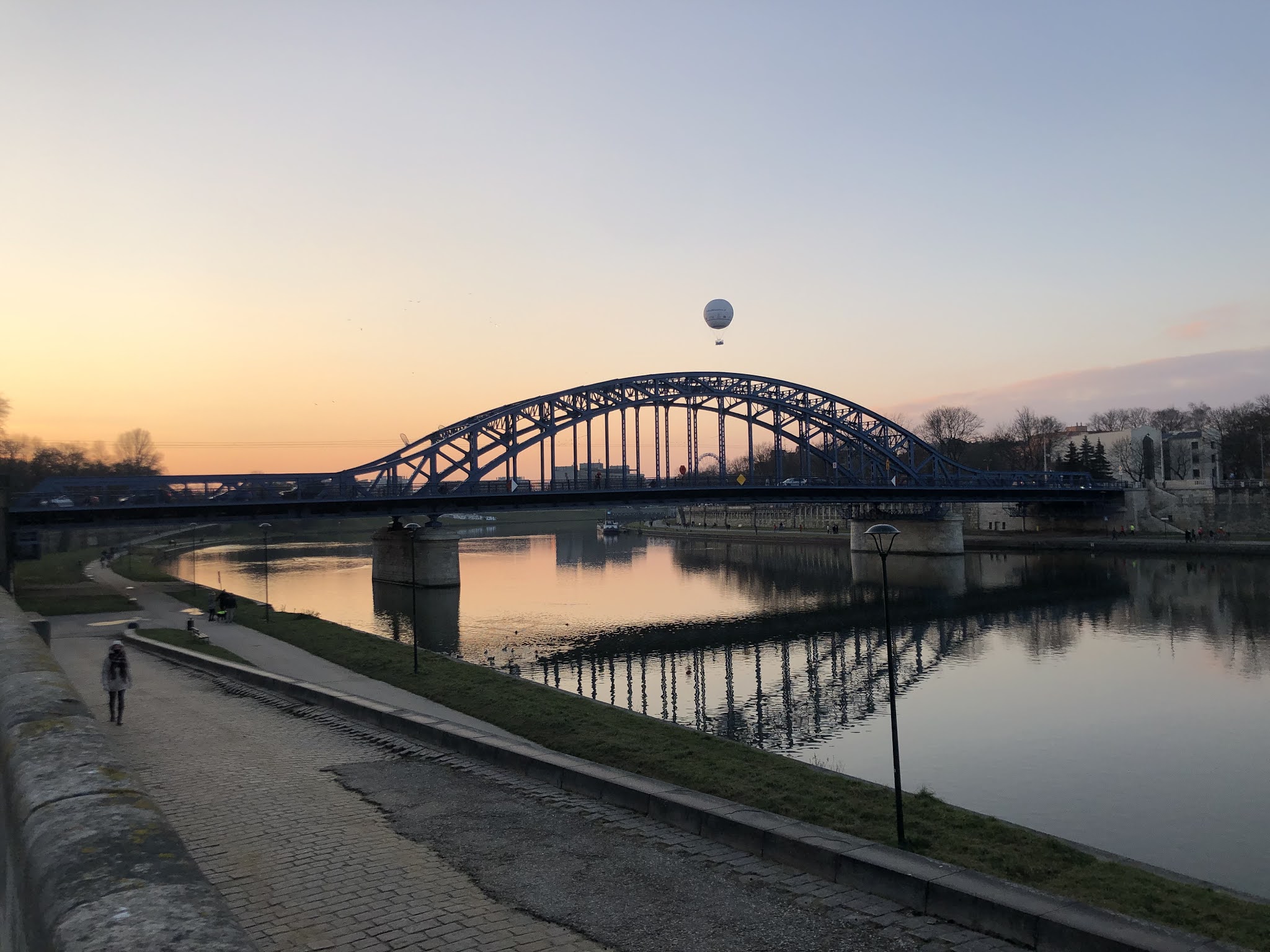
There were a few groups along the riverside. Most were like ours: fairly small (3-6 people), keeping distance from the other cliques, and bundled up. Some of the groups had their own fireworks that they were setting off, some had handheld sparklers, and others had bottles of champagne they were shaking up, but most were just gazing around at the sporadic splashes of light. It was a smoggy night with a low cloud layer, so we didn't see many fireworks other than those that were quite close to our standing point, and judging by the muffled sound, there weren't all that many that we weren't seeing either. In addition, the observation balloon across the river was lit up and flashing fun colors. Although he missed the main event (midnight was rightfully the most flashy), Cameron did talk himself to coming down to the river's edge for the ongoing encore. 

I think it was good to have a fairly modest New Year's celebration. Having a big hoopla like last year would have felt disingenuous (and unsafe) since I am approaching 2021 with much more caution, but it was still good to start the year off with a little bit of fun and optimism. 

New Year's Eve 2020

This was the most exciting it got all evening. It was still very beautiful, but much more subdued compared to the previous New Year's Eve. 

Looking over at one of the other groups next to us along the river. 

We made three pierogi fillings: mushroom and onion, ruskie (potatoes and cheese), and spinach, leek, and cheese. 

I like to eat mine with some unconventional toppings: dill, sour cream, sriracha, rice vinegar, and curry powder. 

New Year's Eve 2019

Looking back at the number of people in this photo bewilders me!

Being in Old Town was somewhat dangerous- you can kind of see that the firework smoke is directly over the crowd of people. 

Again, it's not a great photo, but you can sort of tell that fireworks were being released from the mob into the space right above peoples' heads. 

Monday, December 28, 2020

Kevin

Last year I learned all about the Polish Christmas traditions, for example 24 December is the big family hoopla where you start on a 12 course feast once the first star in the sky becomes visible. Since we committed to the traditions last year, Cameron and I had our own plans for 2020. We had cheese fondue on Christmas Eve, and our 25 December meal also did not meet Polish standards (meaning we did not have barszcz, pierogi, or a carp that had been living in our bathtub for the week leading up to the holiday, nor did we set a plate for Jesus or other unexpected guests).  I did, however, add one Polish tradition to our Christmas table this year–a bundle of hay, which was actually some packing material leftover from a gift that was shipped to us.

Nothing new really came to my attention, except for Kevin. From what I've picked up Kevin is the colloquial name given to the Home Alone movies, probably because the Polish name is Kevin Sam w Domu (literally, 'Kevin Alone at Home'). And Home Alone, as I've learned, is a very popular Christmas movie in Poland. 

For my job's virtual holiday party we played a series of puzzle games, one of which was to watch a five minute clip from the movie and try to keep track of all of the nuances (what color was the phone, what letter is on the doorknob, what did the tall robber get hit in the head with, etc.) There was a big uproar when each group was sharing answers to the question "what is Kevin's last name." Half of the group had correctly surmised that Kevin calls 911 and says his name is 'Murphy.' The other half of the group complained that the question was misguided because everyone knows that Kevin's last name is 'McCallister.' 

As of 2013, Kevin ranked as the most popular Christmas movie in Poland since it was released in Poland in 1992. It seems its popularity is tied with the timing of the fall of communism (1989). It was, after all, one of the early American films, and definitely one of the first Christmas/children films. Apparently Die Hard is also quite popular, and one article writer, Bartosz Staszczyszyn, points out he thinks it's because "Die Hard is essentially Home Alone for adults." 

Maybe I'll have to see if Die Hard can be found for free on the internet, because Home Alone sure holds up! While writing this article, Cameron and had the movie playing in the background (it's free on YouTube). I hadn't seen the film in a few years, and other than the broad strokes I had almost no memories. I'll leave you with some of the winning quotes I jotted down from the first five minutes:

"You are what the French call, 'les incompetent.'"

"When I grow up and get married, I'm living alone."

"Mom, does Santa have to go through customs?"

Like I said, I really enjoyed the movie but watching all of the pain the robbers go through made me feel so bad for them!

I wasn't lying when I said people buy live carp and then keep them in their bathtubs. This tank was set up inside the grocery store and there are plenty more at all of the outdoor markets. 

Leading up to Christmas, Poland loosened some of it's Covid restrictions, including allowing non-essential businesses to open. This store (TK Maxx, not TJ Maxx) was one of the busiest in the mall.

 
I thought our Christmas hay was very cutely displayed with our bunny salt and pepper shakers having a snack out of it. 

We had a really lovely Christmas, including seafood pasta and some good friends. We were within the legal limits for number of people allowed at a Christmas gathering, plus it was nice to band together when none of us had any families we could visit. 

Christmas activities also included gingerbread decorating. 

Not really Christmas related, but I feel an obligation to update you on my mound progress. I did find the fifth and final mound, but it is not worth visiting- it's tiny, fenced off, and right next to a major road. 


Sunday, December 20, 2020

My First Retirement

That's right—I have decided to "retire." My dad thinks this is very funny and he now wants to start a podcast with me, him, and Grandpa discussing retirement across three generations. That probably won't happen (for many reasons, one being that Grandpa can't hear anything anymore) but it is true that I have quit my job and have no intentions of looking for a new one in the foreseeable future. While technically I'm still a PwC employee until the end of the month, I kept my already booked vacation days making yesterday my last working day. I am so excited and relieved!

Yes, I know that actively choosing unemployment is an indicator of my immense privilege. I battled managing that privilege the first time I was a housewife and this time I think it is even more apparent. All I can say is that I am very grateful this option is available to me, but beyond that I won't start another privilege rant here. You can surely see breadcrumbs in my previous posts if you care to re-read them. 

I want to share the background of my time at work and why I ultimately decided leaving my job was the best choice for me. To do that, let me take you on the journey of my employment. *key dream sequence music*

Pre-PwC

When we first moved to Krakow I did not like being a housewife. I was bored, there was no structure to my days, and I had no social life. I didn't need a job for the money, but I wanted a purpose and a community to be a part of five days a week. At that point, too, I thought we would probably live in Poland for three or four years and the prospect of not working for that long was daunting. Even though I was beginning to doubt my previously gung ho resolve to stay in public accounting forever, it was the obvious choice to look for employment since my skillset would be directly transferable and I felt relatively confident they would hire an English-only speaker. Plus, I didn't want my CPA experience to atrophy. I interviewed with PwC on 24 October 2019, got a call the next day offering me the job (with the knowledge that my work permit would need to be approved before I could start working), and then I flew to the US for visa stuff on the 28th. This was all within three weeks of moving to Krakow, so pretty much since the beginning I was ~90% sure I would be working eventually.

I was told to expect the work permit approval process to take 3-6 months, so even when I was unhappy about my housewifing I always knew that it was temporary. However, in the four months between my interview and my start date I started to really enjoy the routine I set for myself. It was plenty of time to build up a social life, plus I think Cameron developed a reliance on me handling all of the administrative parts of life. Essentially, I decided that if the work permit didn't come through, I wouldn't actively look for another job. 

First Impressions

I started at a weird time of year and in a weird position. Coming in mid-February (which also means mid-busy season) as an experienced senior does not lend well to traditional onboarding procedures. Yet, I still received all the standard corporate "welcome onboard" emails and I expected my first week to be pretty low-key; probably sitting in a conference room watching culture-infused training videos. Unexpectedly, two days before my first day I got a text message saying I should meet at the client's office, which of course put me into a little bit of a panic. It did get straightened out and I started in the PwC office on my first Monday morning, but I also ended up spending the second half of the day on the client site.

Right off the bat I was in charge of a few projects. I both liked that the team had enough confidence in me to give me those early responsibilities, but I was also overwhelmed because I was trying to prove my competence while trying to learn so many things from scratch. I had never worked on a for-profit client or in an IFRS environment and trying to catch the nuances while taking a trial-and-error approach to figuring out the general admin and PwC-specific methodologies was exhausting. I know I should have asked more questions early on, but everyone else seemed too busy to burden, plus I wanted to live up to the praise I was getting for being self-reliant and capable.

I also felt like I was a bit of a nuisance because I only speak English. Most of the time in the audit room people would talk amongst themselves in Polish unless I was specifically being drawn into the conversation. That's fine, but it is harder to passively pick up tidbits about your coworkers when you don't follow the rolling conversation. Perhaps if the general stress level was lower I might have been a more active conversation leader so I could insert myself into the discussions better, but probably not since I was still trying to learn my new workplace's etiquette. It might sound like I am complaining about my coworkers—I assure you I'm not—but I felt bad that I was interrupting their routine because I didn't know Polish. I'm not a particularly self-conscious person, but I do pride myself on my ability to fit in and not being able to converse in the "normal" way meant I didn't fit in as seamlessly as I would have liked.

Pandemic

I kept reminding myself that close connections take months, and I did feel like I was making progress connecting with the team. That progress slowed down significantly once we all began working from home, which was less than a month after I started at PwC. This was terrible timing because now the casual information gathering I did have was cut off. Working from home took away my ability to gauge "normal" working hours and daily productivity. I also could no longer call out to the room and ask, "does anyone know how to..." but instead I had to choose to impose my question on someone. The problem was I didn't have enough of a relationship with anyone yet to feel comfortable constantly pinging my problems to. 

There were good things about working from home, though. I liked that I no longer had a commute and I could eat whenever I wanted (rather than waiting for the group to collectively decide it was lunchtime). It also made me very grateful to have a job. When Poland did a full lockdown I was so thankful to have something specific to focus on each day. There was also a lovely two month period of time where we were told not to work any overtime and I really liked working a true eight-hour workday. Like everyone else, my team figured out how to adjust to the virtual environment and I began to feel like I (kind of) knew what I was doing. 

Stress & Anxiety

As is the nature of public accounting, as soon as you start to feel confident with one aspect of the job things are bound to change. Some key members of my team left PwC, leaving a handful of projects to be distributed amongst the remaining seniors. When available, people transitioned onto our team to fill in but it still meant more projects were falling into my lap. I didn't have a good sense of how long things would take, so when I was told I should be able to finish up part A today and get through parts B-D by the end of the week I would meekly agree that it seemed possible. But "possible," I learned, only happened in an ideal world and we were not living on that planet.

For example, the initial project I was assigned on my first day at PwC should have wrapped up in less than two weeks. It took me about double that time, partially because of the learning curve, partially because I was also trying to juggle other side projects, and partially because the client was not ideal. And that was only to mostly finish. There was one little holdup, and while I waited for that to be resolved I focused on other projects. Periodically, I would have a lull and would check in on the little holdup—sometimes I would be able to progress a smidge further but typically I was told, "it will happen soon." That little holdup stayed in limbo for months and months, and ultimately it never was resolved in the 10+ months at the job. 

Some people would be able to brush that off with a "not my problem" attitude. I am not one of those people. I really care about my work and I work off a running checklist, so until something is truly done it lingers on that list indefinitely. Effectively that results in a very long list, and long to-do lists are really just a visual representation of increasing stress. Some weeks I did take those on-hold projects off the list, just to manage my stress a little bit, but even so I knew that if that one little piece came through it would be all hands on deck to finalize that project. 

The workload was definitely the most potent ingredient in my personal anxiety cocktail, but it wasn't the only one. I started to be part of weekly calls with the client which were fully in Polish until it was my turn to speak; again, that's fine, except I couldn't gauge if I was using the right tone or saying the right things because I couldn't match the others. I was also learning that my options to get CPE (continuing professional education—a requirement for maintaining my CPA status) were very limited, which left me to seek out webinars outside of work. Essentially, I would take the same trainings twice–once for work and once for CPE—and the CPE ones would always be at weird hours (think 10 pm on a Tuesday) thanks to the time difference. 

I also wasn't getting to enjoy my favorite part of my job, which is helping and teaching others. Yes, I periodically had an associate working with me whom I would guide via video chats, but most of the time I felt so bogged down with my own workload that I didn't feel like I could be an effective guide to others. It both helped and hindered having new people rotate onto our team as I could sympathize and commiserate with them about the onboarding process, but since I couldn't dedicate much time to them I also knew I was perpetuating the stressful cycle the "figure it out yourself" attitude creates. 

Quitting Thoughts

There were some ups, but it seemed like the ups only came after a long series of downs. I had one project (which ended up expanding into three or four, but that's a different story) that we needed to finish by the end of August. I had many 12+ hour days leading up to 31 August… and then we didn't issue. Panic mode kept on rolling for another week and that's probably when I first started toying with the idea of quitting.

It took me a long time until I truly decided to quit, but I started testing out the idea with small things. I laid out my grievances to see which ones would be acted upon. My boss agreed I shouldn't work longer than ten-hour days, and I was tentatively granted a week off during busy season for a ski trip in the Alps. Also around this time, Cameron and I decided we would only stay in Krakow another year so I knew I would need to quit by mid-summer 2021 anyways. Every change (good and bad) helped to hone in on when in our 12-month scale I would quit. 

My mood was souring and the urge to quit kept growing, especially as my expectations about project competition dates kept getting dashed over and over again and more and more of my coworkers quit. I'm pretty positive (even for an American) but I was having a harder and harder time maintaining a professionally cheerful attitude. I tried lots of remedies: meditation apps, gratitude journals, CBD oil, Bright Mood tea, and breathing exercise all supplemented my already daily exercise and weekly socializing routines. Although they probably helped to some extent, I still kept inching closer to the "quit now" side of the scale.

Decision Time

Even with my mood-lifting attempts I was still crying regularly. (Maybe another pro to working from home is that you can cry while you work and no one has to be the wiser?) Somewhere in the late September time frame everything compiled together and culminated in a panic attack. I was already starting to tear up thinking about the absurd number of things I needed to do when an email came through with another set of impossible tasks. I started to feel dizzy, I couldn't breathe, and I wanted to throw up. I made it to the bathroom where I sat on the toilet lid and leaned into the wall so that the cool surface could cool my now-sweating face. 

I heard a statistic (that I will probably misquote) that Americans typically feel miserable for five years before they will seek out help. I was not willing to be an average American. At this point I tried my final maybe-I-won't-quit option and I made an appointment with a counselor. 

I signed up via a counseling service that PwC provided. My call was in mid-October and I was a little hesitant to complain about work to someone provided to me by my employer. I quickly learned that the counselor I was matched with had no practical knowledge about what PwC does and I opened up about my complaints. I expected she would be a mostly passive listener who would leave me with some tips on how to manage my stress better. Somewhat to my disbelief, she seemed very invested in my plight and told me I wouldn't be able to thrive so long as I kept having to operate in survival mode. She adamantly agreed that I needed to fully disconnect from work, whether through quitting or via a psychologist-prescribed mental health sick leave. I set a time slot in my bosses' calendars for the next week to share my "2021 intentions."

Practicalities of Quitting

In Poland, if you have worked at a job for more than three months you have to give a minimum one month's notice. I wanted to give a full two months because I wanted my transition to go as smoothly as possible. I figured with two months they would be able to find my replacement and I would be able to finish up everything on my to-do list. On 27 October, I formally announced my intentions to only continue working for PwC through the end of December. 

The reasons I gave for quitting were all sincere. I was truthful that the stress was negatively impacting my mental health and that I did not want to subject myself to a full busy season's demands. I shared that I wasn't getting some of the simple things I wanted out of this job (CPE, community) and that I wanted to ensure I had time to enjoy living in Europe. I admitted that I didn't feel like I was a good employee and that I constantly felt I was outputting at a mediocre standard. Another big reason was that I didn't feel like I was making the world a better place by auditing a huge telecommunications client. I know from my experience with nonprofits and tribal governments that I am willing to put up with a lot of shit if I feel like I am assisting with a greater mission of good. 

I knew my announcement was a blow to my team, but amazingly everyone was happy for me and really supportive. I caught a glimpse of jealousy in some people—I'm sure quitting had crossed their minds at some point as well. I knew it would have to happen, but I still felt guilty as I watched my unfinished tasks being doled out to the few remaining team members. I wasn't sure how much to share, or how widely to share it, so I found myself giving cryptic responses to the client and some colleagues as the topic of 2021 planning came up in conversation. 

The last few weeks were by no means a breeze, and in some ways they were the toughest weeks of the year. I think if I didn't have the knowledge that it would be over soon I probably would have had a second panic attack. At one point my manager asked if I would be willing to extend my time for a few weeks if the current projects didn't wrap up by the end of December. I snapped at him and not-so-politely said, "definitely not. I am fed up with this job. The reasons these projects are still ongoing are not my fault and I feel no obligation to fix the problems that other people made." Yes, that was not a shining moment, but I am happy to say I did fully wrap up the one huge project that everyone was most worried about on my last day.

Looking Back

I know that I did not handle everything ideally. From the beginning I could have been more open about my concerns and I could have been more upfront with my questions. I could have tried to better separate myself from my work and I could have been more demanding about my needs. I could have stayed for a full year. I could have played it out even longer and just kept at it until we moved. If I wanted, I'm sure I could have even kept going beyond that by transitioning from PwC Poland to PwC USA. 

I could have, but I didn't, and that's ok. Clearly, I felt like there were plenty of reasons to quit, but I also had many reasons to stay which made the decision not-so-clear-cut: I like having purpose, I like making money, I care about my coworkers, I worry I'm unfairly attributing pandemic/politics/expat stresses to work, I pride myself on not being a quitter, I'm worried that a multi-month gap on my resume will make it harder to get a job, I also worry that my knowledge/skills/drive/critical thinking will disintegrate the longer I don't work, and biggest of all—I don't like disappointing people. 

Quitting was hard and scary, but I'm really proud of myself for going through with it. When I was still debating with myself, one friend shared his story of quitting a job and the relief it brought him. That was the predominant emotion I felt, too. There was also excitement and anticipation but the relief is still so strong I'm almost giddy. 

All that said, I am grateful for this job. As one coworker put it, "it was quite absorbing and particularly unusual," but I made good connections and I learned a lot. Many of the lessons learned were about myself rather than about audit and accounting, although there were plenty of those, too. I've finally admitted to myself that counter to popular opinion, I want to be a big fish in a small pond. Also, and probably more importantly, I now know that I won't be fully satisfied unless I connect to my work's mission. We'll see how those come together for my next act. 

What's Next? 

When I was feeling particularly frustrated and overwhelmed, one of my outlets was to fill out two lists: 1) other things I could do with my time, and 2) other jobs I could consider. I won't look for another job while I'm in Poland. For one, I don't really have time to go through the job permit process, but also I don't really know what I want to do next. Some of my other jobs are accounting- and finance-related, but I also have a few wacky ones on there, too. My favorites are: environmentalist, party planner, licensed joyologist, dating advisor, and local government official/mayor. Before I commit to the next phase of my career I want to take this time to truly figure out what I want to do and what I require out of a job. I'm considering this my first retirement since it will be a time to reflect, relax, and recoup. 

Although I don't have a title to give myself at the moment other than "housewife," I don't think I will be wearing the stereotypical housewife heels and pearls this time around. This time, housewifing is completely my choice and I have a plan! I anticipate splitting the average day into segments: three hours for life planning, three hours for education, two hours for reading, and one hour of exercise will make up my workday. I have a few big personal projects that I've been daydreaming of for months now and I'm excited to finally get started on them. I'm also offering my services as a copy editor, resume reader, mock interviewer, vacation researcher, and old undies mask maker.

I may not know exactly where I'm going next, but I know I made the right choice for me right now. 

Just a pretty photo from one of Wawel Castle's archery holes. I suppose you could apply some related inspirational message like "bright look at the future" to make the photo fit the theme, if you want to. 

One week I had three late nights of CPE in a row. I started to watch the webcasts from the bathtub to try and decrease my stress levels even though it still felt like I was working at 10 pm. 

The doodlings of an unhappy employee. 

I wasn't kidding when I said I would make you a mask out of your old underwear, but no promises that they'll look very good. I can promise, though, that I'm a pretty good resume editor and proofreader.